
CRITICISM “CIRCLES OF MATTER AND TEMPORARITY
Jordi Plana. Circles of matter and temporality
Jordi Plana’s artistic practice encompasses a range of very diverse disciplines and techniques. However, they all share a certain air of family that unfolds the same research: that of aesthetic experience that places matter and temporality at the center of his discourse.
Thus, although in a first reading there appear references to the sea, to memory, to remembrance or to natural matter, which act as gateways to the artist’s universe—in a second interpretative reading, wearing a piece of jewelry or walking through the exhibition space activates a different relationship with the work.
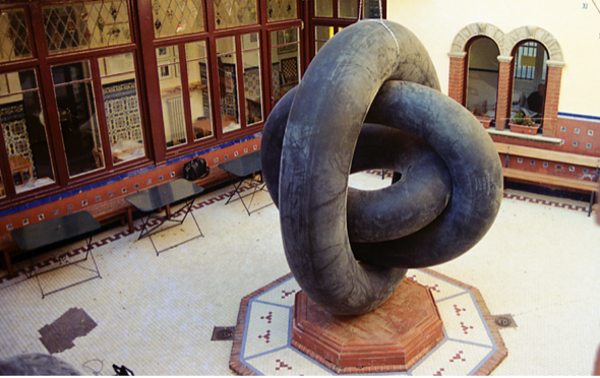
Elements such as the amphora or the sea function as both metaphors and forms of experience. Each object assumes the figure of the circle in a particular way, whether in the tire, in the mouth of the amphora, in the jewel and also, figuratively, in the cyclical movement of the sea or in the journey within the exhibition space.
These circles, which run through the entire work, activate a temporality that rotates, returns and transforms. Thus, while natural elements such as rubber, bronze or copper, construct an amalgam of material perceptions, the amphora establishes, for its part, a singular relationship with time.
In this way, a historical object, intended to contain and transport wine, is displaced from its original function. Far from being evoked as an archaeological relic, the amphora is presented as a fully contemporary object. The jewelry intensifies this experience: the pieces are wearable, which implies a physical and at the same time temporal relationship with the work, which accompanies the present of the everyday gesture.
The exhibition space, for its part, is an integral part of the work that is presented there. As the French philosopher Maurice Merleau-Ponty pointed out in Phénoménologie de la perception , “the body is not in space like a thing, it inhabits space, it structures it”. Our body, therefore, is fundamental when it comes to situating ourselves in the world and, therefore, also in an exhibition space, since in addition to occupying that space, we inhabit it. In this sense, the exhibition establishes an inseparable dialogue to complete the aesthetic experience that the artist proposes with his work.
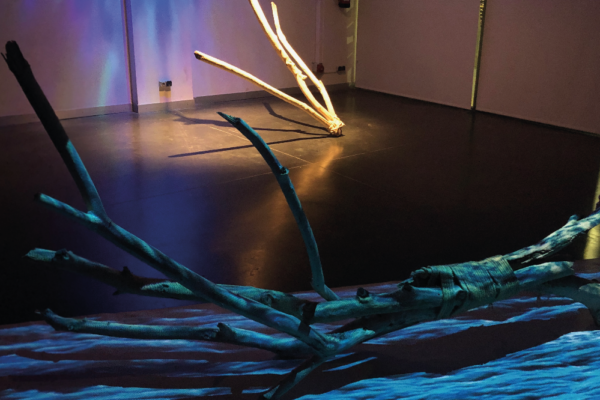
At the beginning of the tour, an anchor, located in front of the glass of the gallery facing the street, introduces a first experience of rooting. The lighting that suggests the seabed generates an atmosphere that invites a slow and attentive perception: the work acts as the starting point of the journey.
In the middle of the room, The Medusa occupies a central position. Its presence establishes a direct relationship with the observer and generates a feeling of exchange. The work seems to observe at the same time as it is observed.
At the end of the tour, a video projected onto a translucent canvas allows us to glimpse the medieval stone wall of the space. This superposition of moving images of historical architecture constructs a stratified perception in which the present of the projection coexists with the materiality of the past.
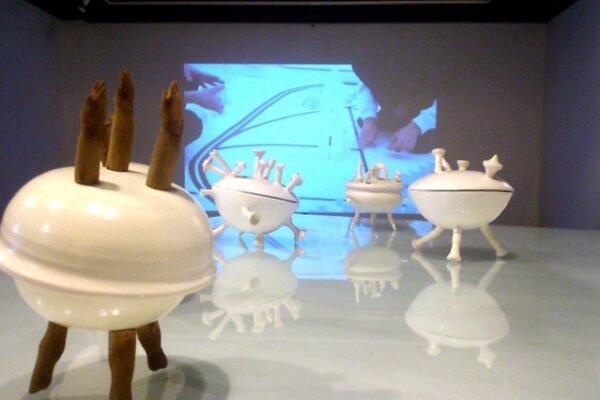
In between, on the lower floor of the room, we find the amphorae created by Sandra Ovejas , which, illuminated with a dim yellow light, introduce a singular temporality. The amphora, an object linked to the sea and circulation, is presented here as a material body that accumulates time and use.
This route is crossed by a set of eight glass display cases, which present models and other materials corresponding to sculptures already made previously. These pieces allow us to visualize the artist’s creative and research process in a small format. The models are conceived as works in themselves, so the artist calls them “sculptural jewels”, establishing a direct relationship between the sculptural gesture and jewelry.
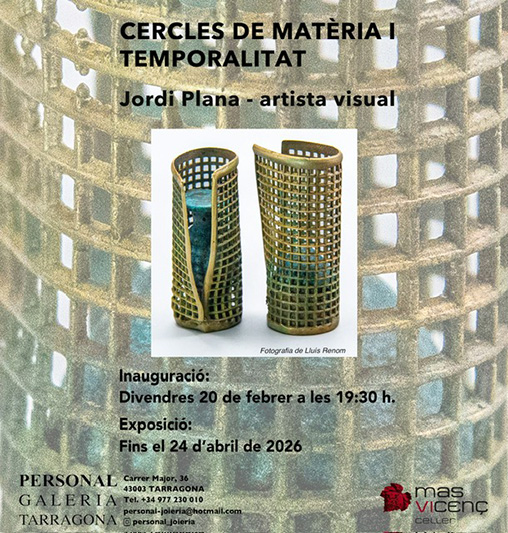
The set includes jewelry related to the sea (rings and copper amphorae made with the electroforming technique, as well as bronze microfusion pieces). In the most recent creations, a dialogue is established between the amphorae and the grilles that surround them, reinforcing the materiality of the proposal.
In short, Jordi Plana’s work offers us, in addition to an immediate reading, a singular perceptual situation that emerges in the relationship with forms, materials, space and time.
Felip Vidal , February 2026